Gold and Bitcoin are increasingly framed as competing reserve assets, but the more important question is how they coexist within a changing monetary architecture. Enrico Rubboli, Founder and CEO of Mintlayer, explores how physical scarcity, algorithmic scarcity, and tokenized real-world assets are converging. At Mintlayer, we build Bitcoin-native infrastructure that enables scarce assets to move and settle on rails secured by Bitcoin. As capital shifts between physical stores of value and digital alternatives, this debate becomes structural rather than theoretical. How these assets interact will define how the next generation of reserve instruments is issued, settled, and custodied, and ultimately where programmable finance is heading.
1. Introduction: 1971, 2009, and the Question of Trust
On August 15, 1971, Richard Nixon closed the gold window.
With a short televised address, the United States abandoned the last operational constraint on monetary expansion. Dollars were no longer redeemable for gold. Money became political credit, backed by confidence and enforcement rather than convertibility.
Thirty-eight years later, in January 2009, a pseudonymous developer released a nine-page paper and a small piece of running code. Embedded in the first Bitcoin block was a quiet accusation: the system had failed again. This time, the response was not reform but exit.
Since then, investors have been forced into an uncomfortable comparison. On one side, the shiny yellow rock. Heavy. Tangible. Trusted because it has survived empires. On the other hand, mathematical truth. Weightless. Abstract. Trusted because it removes discretion.
Both now compete for capital allocated to store of value assets. Treating them as rivals misses what actually drives demand. Gold and Bitcoin are not substitutes. They are tools for different anxieties.
Gold appeals to investors worried about slow decay: inflation, institutional drift, fiscal fatigue. Bitcoin appeals to investors worried about rupture: capital controls, seizure, monetary reset. One defends. The other attacks.
That distinction matters.
2. The Hard Money Argument
Gold and Bitcoin provoke the same reflexive hostility from central banks for one simple reason.
They cannot be printed.
That sounds ideological. It is not. It is mechanical.
Scarcity Without Permission
Gold’s scarcity is geological. Bitcoin’s scarcity is algorithmic. Both sit outside committees, elections, and emergency meetings.
Supply dynamics
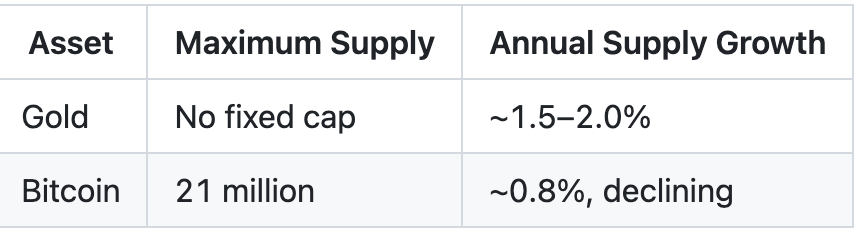
Gold’s stock-to-flow ratio sits near 60. Bitcoin crossed that threshold after the 2020 halving and will keep widening. This is not narrative. It is arithmetic executed on a schedule.
Central bankers understand this instinctively. Assets that cannot be expanded reduce policy flexibility. They expose excess. They discipline balance sheets by offering an exit hatch.
That is why both assets are tolerated during stability and criticized during stress.
Analog Anchor, Digital Extraction
Gold is an analog anchor. It stabilizes by being slow, inert, and inconvenient. Those frictions discourage impulsive capital flight and reward patience.
Bitcoin is digital extraction. It removes value from discretionary systems and transfers it across a neutral network at machine speed. No trucks. No vaults. No intermediaries deciding whether your transaction is acceptable.
The shared hard money property explains why both attract macro capital. The structural differences explain why they behave nothing alike.
3. Where They Diverge: The Volatility Tax
This is the section most people skim. That is where the real disagreement lives.
Bitcoin collapses. Regularly.
Anyone pretending otherwise is either new or selling something.
Drawdowns of 70–80% are structural. They happen because Bitcoin is still discovering what it is worth when stress hits. Gold investors love to point this out, usually without mentioning that they tolerated twenty years of real losses without calling it a failure.
Bitcoin volatility vs Gold
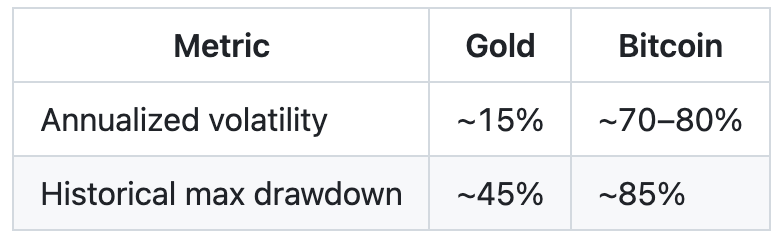
Gold’s declines are slow enough that they feel polite. Bitcoin’s are violent enough that they feel existential. Psychologically, those are not the same experience.
From 1980 to 2000, gold quietly destroyed purchasing power for two decades. I have sat in allocator meetings where gold was praised for stability by people who had not checked that period since the Clinton administration. Selective memory does heavy lifting.
Price Discovery vs Monetization
Gold is fully monetized. Its role is finished. It trades, settles, and stores value inside a system that knows exactly what to do with it. That maturity is why it works as insurance and why it is boring.
Bitcoin is not there yet. It is still in price discovery, and price discovery is ugly. Adoption does not arrive smoothly. It arrives in surges, overshoots, and collapses.
Expecting Bitcoin to behave like gold today is not conservative. It is confused.
Bitcoin’s instability is the cost of trying to become money in public.
4. The Custody Problem
This is where theory meets logistics.
Moving one billion dollars in gold requires armored transport, insurance syndicates, customs declarations, and political exposure at every border crossing.
Moving one billion dollars in Bitcoin requires bandwidth and keys.
That asymmetry is operational, not philosophical.
Confiscatability
Gold can be seized. History proves it.
In 1933, Executive Order 6102 criminalized private gold ownership in the United States. Many jurisdictions followed similar paths under stress. Physical assets inside borders remain legible to power.
Bitcoin changes the attack surface. Custody can be reduced to information. A seed phrase memorized, split, or geographically dispersed does not sit in a vault waiting for a court order.
This does not make Bitcoin safer. It makes it different. Risk shifts from physical seizure to personal operational failure. Many investors are not equipped for that responsibility.
There is no moral winner here. Only trade-offs.
5. The Hybrid Solution: When Gold Runs on Rails
This is where traditionalists get uncomfortable. That discomfort is overdue.
Tokenized Gold is not a side show. It is an admission that gold’s physicality, while philosophically appealing, is operationally clumsy in a digitized financial system.
What Tokenized Gold Actually Is
Tokenized Gold instruments such as PAXG or XAUT represent claims on vaulted gold issued as blockchain tokens. The metal does not change. The ownership model does.
That distinction matters more than the marketing suggests.
Why It Matters
Tokenized Gold fixes gold’s worst problem: settlement friction.
Operational comparison
- Physical gold settlement: days or weeks
- Tokenized gold settlement: effectively immediate
- Divisibility: fractions that make bars look archaic
- Transferability: global, subject to issuer cooperation
For portfolio managers dealing with collateral movement, margining, or cross-border liquidity, this is not cosmetic. It changes how gold can actually be used.
This is gold that finally fits modern rails. It turns a centuries-old asset into a functional RWA (Real World Asset) inside digital systems.
The Catch: Counterparty Risk
Here is where optimism should stop.
Tokenized Gold is not sovereign gold. It is IOU gold.
Unlike Bitcoin, it is not trustless. Unlike physical gold in hand, it is not a bearer asset. You are trusting:
- The issuer
- The vault operator
- The legal enforceability of redemption
That counterparty risk is real. It must be priced.
For many allocators, this compromise is acceptable. For some mandates, it is disqualifying. Ignoring the distinction is indefensible.
A Prediction That Will Upset Someone
Within a decade, most gold trading volumes will be tokenized. Liquidity migrates toward speed and programmability.
Central banks will still hoard physical bars.
They are not optimizing for efficiency. They are optimizing for control.
6. Risk-Adjusted Reality
Narratives fade. Ratios remain.
When viewed through a Sharpe ratio lens, Bitcoin has compensated investors aggressively for the risk it imposes.
Indicative long-term Sharpe ratios
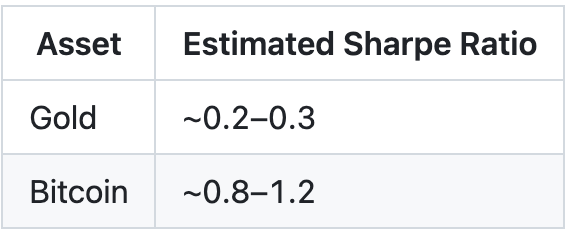
Gold’s role is survival. Bitcoin’s role is repricing power structures. That ambition carries instability.
Conflating those objectives leads to allocation errors.
7. Complementary Forces, Not Rivals
Gold protects purchasing power during slow institutional decay. Bitcoin captures upside during rupture and reconfiguration. Tokenized Gold adds a third layer: efficiency.
A modern portfolio that ignores gold is fragile. One that ignores Bitcoin is conservative to the point of denial. One that ignores Tokenized Gold may be ignoring how capital actually moves.
The real question is not which asset wins.
As the US dollar shifts from unquestioned reserve to negotiated standard, which form of trust scales better: physical inertia, cryptographic certainty, or regulated digitization?
Discover more

Is Crypto dead?
Is crypto dead? Mintlayer is a solution to many current problems in crypto. See how users are immune from the same types of losses FTX users face.
GameStop fuss is just another reason why the world needs Mintlayer
When WallStreetBest pushed the GameStop shares to unimaginable highs by betting against the hedge funds that kept shorting, it had shown once again how decentralized finance is unquestionable necessity for our times.

Bitcoin sidechain Mintlayer is the new standard for securities and stablecoins
The financial system's future is an ecosystem of tokenized assets.